Atradius Atrium
Portail clients en ligne pour accéder aux informations sur votre contrat et aux outils de gestion de vos limites de crédit.

Termes de recherche populaires
 France
 Allemagne
 Australie
 Autriche
 Belgique
 Brazil
 Bulgarie
 Canada
 Chine
Chine
 Danemark
 Émirats arabes unis
 États-Unis
 Finlande
France
Finlande
France
 Grèce
Grèce
 Groupe
 Hong Kong
 Hongrie
 Inde
Inde
 Irlande
 Italie
 Japon
Japon
 Lituanie
 Mexique
 Norvège
 Nouvelle-Zélande
 Pays-Bas
 Pologne
 Portugal
 République tchèque
 Roumanie
 Royaume-Uni
 Singapour
 Slovaquie
 Slovénie
 Spain
Spain
 Suède
Suède
 Suisse
 Turquie

As survey data shows, Poland currently stands out in Central and Eastern Europe (CEE) as one of the most cautious users of trade credit in business-to-business (B2B) transactions. On average, just over one third of B2B sales are made on credit, the lowest share in the region. This reflects a clear preference for cash payments, as companies seek to limit risk in an uncertain environment. However, the picture is beginning to shift. Medium and large firms in manufacturing are gradually increasing their use of trade credit, pointing to growing confidence in credit-based trading relationships. Poland may therefore be moving towards closer alignment with the rest of the region.

Where B2B trade credit is used, Polish companies maintain tight control. More businesses in Poland than in the region offer payment terms within 30 days from invoicing, pointing to a controlled approach to payment policies. The expansion of trade credit use, therefore, is not accompanied by looser payment terms, confirming that sales growth remains carefully managed. This contrasts with the broader regional pattern, where companies are more likely to extend terms to support sales growth, even at the cost of higher payment risk.
Against this backdrop, late payments appear to be slightly more frequent in Poland than in CEE, with medium firms in trade most affected. However, the overall share of overdue invoices in Poland is slightly lower than regionally, suggesting that delays tend to resolve faster, within one month past due. This limits escalation into credit losses, with most cases remaining below 2% of past due invoices and relatively few large write-offs. The difference becomes clearer at the extreme end. CEE records a higher share of very large overdue exposures, above 10%, pointing to more frequent severe payment issues. Customer insolvency remains the main cause and is cited more often in Poland than in CEE.
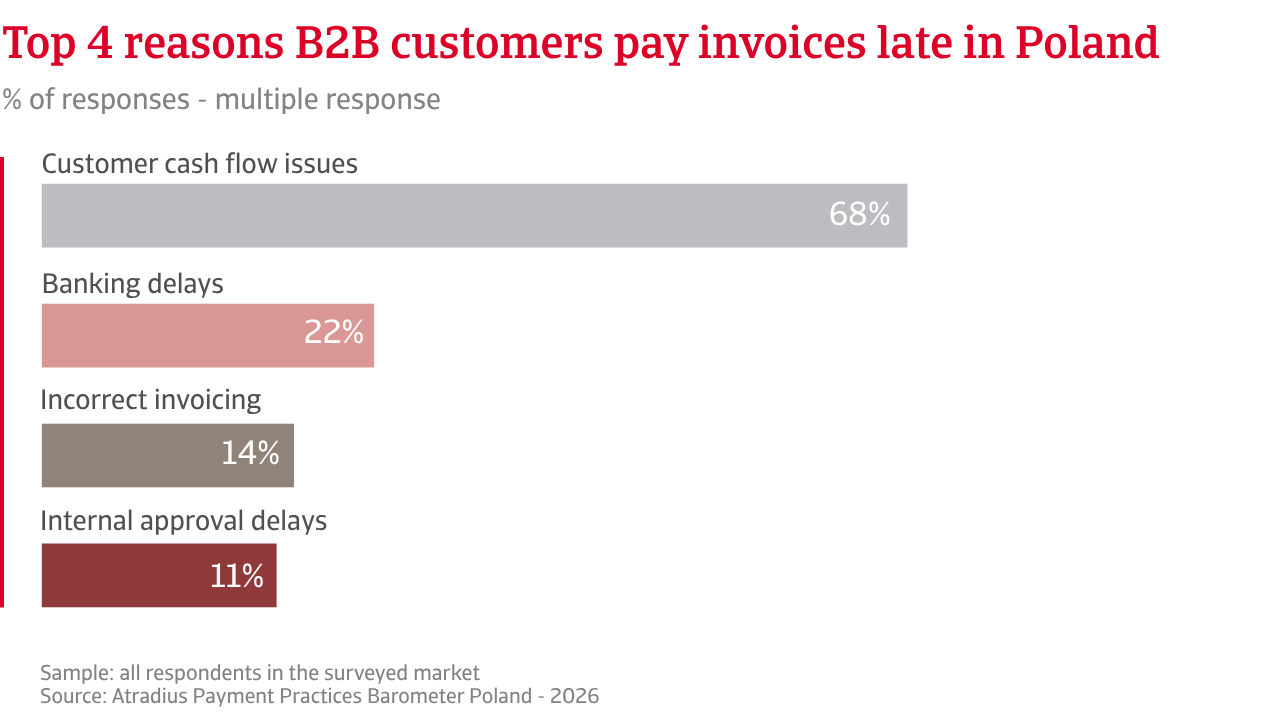
The operational impact remains. Late payments and bad debts continue to reduce the cash available for day-to-day business. However, fewer companies report severe strain compared with CEE. While reliance on external financing is increasing and cash flow planning remains challenging, the situation appears more manageable overall.
Polish companies respond in a practical way. Rather than relying heavily on financial instruments or restricting trade, they focus on tighter payment terms, active negotiation and building internal buffers. Around one in five companies in both Poland and CEE use credit insurance as part of their risk management approach, particularly medium-sized trade businesses, which are more exposed to late payments. Overall, survey findings for Poland point to a market in Poland that remains cautious but is steadily evolving, with growth in trade credit supported by strong risk control.
On average, just over one third of B2B sales are made on credit, the lowest share in the region. That said, trade credit use is slowly growing, especially among larger manufacturing firms.

Most businesses in Poland do not expect significant short-term changes in the current status of B2B payment behaviour. This view is also common across CEE, although slightly fewer companies share it. Among those anticipating change, Polish firms show somewhat greater confidence in an improvement in payment behaviour than their regional peers. This aligns with Poland’s more controlled risk profile, where payment delays tend to be resolved more quickly and are less likely to escalate into severe issues.
Expectations around insolvency reinforce this cautious but stable outlook. More companies in Poland than in CEE believe insolvency levels will remain elevated rather than worsen further. At the same time, fewer Polish firms expect a rise in insolvencies compared with the regional average. A notably higher share of respondents in Poland reports no clear view on the outlook, pointing to a degree of uncertainty about the direction of the economic environment.
Profit margin expectations remain moderately positive and broadly aligned with those in CEE. This suggests that, despite differences in payment dynamics, businesses share a similar level of caution around profitability. Cost pressures, competition, and tighter financing conditions continue to weigh on margins, limiting upside potential even in markets where payment risks are better contained.
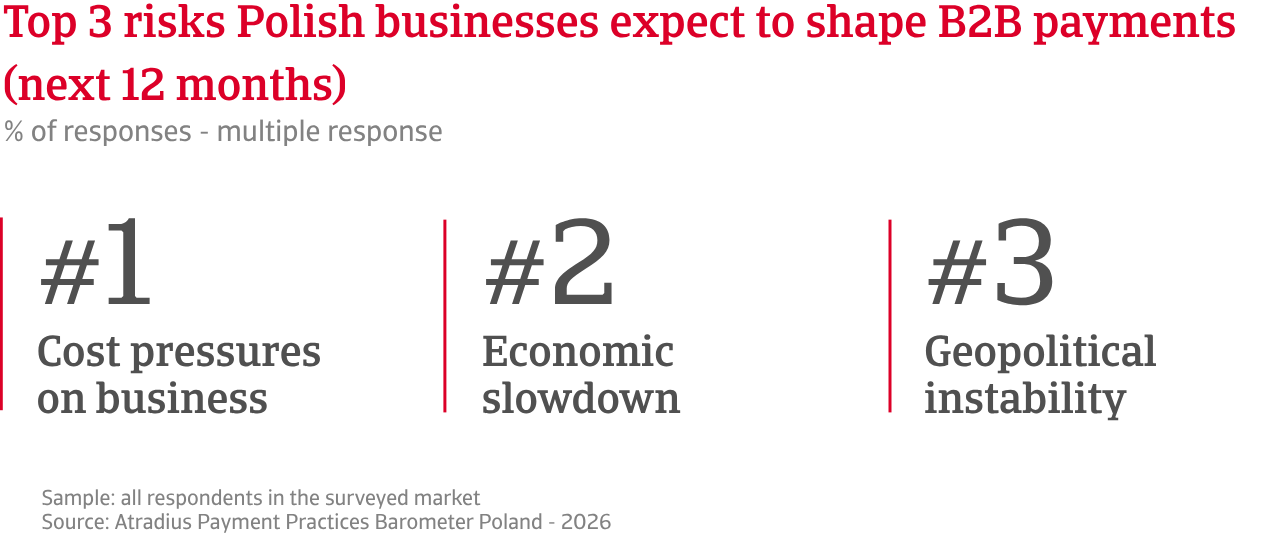
When looking at the risks most likely to disrupt B2B payment behaviour in the coming months, Polish companies point to a broad and diversified set of concerns. Inflation and cost pressures rank as the leading risk, followed by geopolitical instability and sector specific downturns. There is also relatively strong focus on operational risks, with cybersecurity threats and regulatory changes cited more frequently than in CEE.
In contrast, businesses across CEE place greater emphasis on macroeconomic risks. Economic slowdown stands out more strongly than in Poland, while inflation concerns remain high across both markets. Some risks are closely aligned, particularly interest rate increases, highlighting shared financing pressures.
A key difference emerges around fraud risk, which is cited far more often in CEE than in Poland. This suggests a higher perceived exposure at regional level, while Polish firms appear less affected by this issue.
Overall, Poland shows a more balanced and forward-looking risk profile. Companies combine awareness of external pressures with a strong focus on operational resilience. In contrast, businesses in CEE appear more exposed to broad macroeconomic shocks, shaping a more reactive risk perspective.
For a full overview of the 2026 survey results for Poland, please download the market specific report from the related documents section below. Insights into Central and Eastern Europe (CEE) are available in the related content section below.
To explore how to strengthen your own credit risk strategy, get in touch with us and see how we can help you stay ahead.